
Harry Altman Buffalo's Master Showman

Release of book
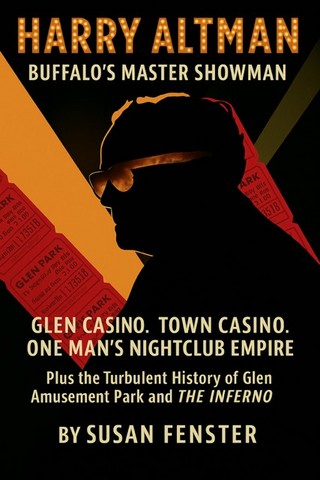
Historian publishes new book on Harry Altman
by AMY WALLACE, Amherst Editor 11/6/25
A notable part of Williamsville’s history is being brought back to life in a new book about to be released by Historic Preservation Commission Chair and Village Historical Society Board Member Susan Fenster.
Fenster has published a new biography documenting the life and legacy of Harry Altman, the son of Jewish immigrants who built two of Western New York’s most celebrated nightclubs and helped elevate Buffalo’s entertainment scene to national prominence. Altman operated the former Glen Casino on the site of Glen Park in Williamsville and the Town Casino at the site of the now Town Ballroom in the City of Buffalo for decades in the 1930s until the 1960s.
Altman’s Glen Casino in Williamsville and Town Casino in downtown Buffalo stood shoulder-to-shoulder with the country’s top venues, attracting world-class performers such as Sammy Davis Jr., Duke Ellington, Vic Damone, Al Martino, and Johnnie Ray for having three shows a night.
“I started working on the book right before COVID hit,” Fenster said. “It took five years and when I started with the libraries being closed, I had to do interviews before research.”
Fenster said she decided to write a book about Altman and the Glen Casino and Amusement Park, remembering how she went to the small amusement park there as a child.
“At one point, Glen Park where the casino sat was flat,” Fenster said. “The casino was 140,000 square feet and hosted performances from the likes of Sammy Davis Jr. and other top entertainers at the time. It’s hard to imagine how it was seeing how it is now.”
Fenster said she wanted to learn more about the man behind the casino and the history of the area which became Glen Park in 1976.
According to Fenster, Altman was the youngest of Russian-Jewish immigrants and began his career as a glove salesman, traveling the Northeast and making friends with future film mogul Sam Goldwyn. By the early 1900s, he was hustling as an event promoter and co-owner of small roller rinks and dance halls. On the brink of financial collapse during the Great Depression, Altman took a gamble on a struggling eight-acre picnic grove in Williamsville, transforming it, through vision and relentless work, into the Glen Casino, a dazzling hub of nightlife, laughter, and music that placed Buffalo firmly on the national map.
“Altman’s story is the story of Buffalo itself,” Fenster said. “He was the son of immigrants who built something extraordinary from nothing, a dreamer who believed this city could shine alongside America’s great entertainment capitals.”
Even though Altman brought Williamsville and Buffalo into the national spotlight at the time with mentions in Billboard and other major national columns and solidified his reputation as a showman whose venues could rival the best in New York and Chicago, he also faced antisemitism and other challenges along the way.
By the 1960s, the rise of television and the lure of Las Vegas dimmed the regional nightclub circuit, forcing both the Glen and the Town Casinos to close just months prior to Altman’s death in 1966. Altman’s son-in-law David Goldstein revived the Glen Park venue into the Inferno, a popular and influential rock ‘n’ roll venue hosting stars like Sly & the Family Stone and The Bob Seger System. The Inferno closed in 1968 following a large fire that destroyed the building, bringing an end to several decades of live music performances.
“‘Harry Altman: Buffalo’s Master Showman’ brings to life the story of a man who bridged the Old World and the new, helping define an era when Buffalo’s nightlife could hold its own on the national stage,” according to Fenster.
Fenster graduated from Buffalo State College with degrees in history and journalism and has written extensively on New York state’s social and cultural heritage. “Harry Altman: Buffalo’s Master Showman” will be released on Amazon on Nov. 13 and in print shortly thereafter.
Susan Fenster's Bio
Susan Fenster is a historian and writer based in Western New York. A graduate of Buffalo State College with degrees in history and journalism, she has written extensively on New York State’s social and cultural heritage. Harry Altman: Buffalo’s Master Showman is her most ambitious chronicle of local entertainment history to date.
Book Info
A Summary of Harry Altman: Buffalo's Master Showman
A new biography, "Harry Altman: Buffalo’s Master Showman," traces the remarkable journey of a Russian-Jewish immigrant’s son who built the glittering Town Casino and Glen Casino, bringing world-class entertainers to WNY “three shows a night.” Altman’s success came despite formidable challenges: antisemitic barriers in business and show business, pressures from organized crime, and the shifting tides of postwar entertainment. Yet his perseverance and flair for promotion earned Buffalo mentions in Billboard and other major national columns, solidifying his reputation as a showman whose venues could rival the best in New York and Chicago.
Harry Altman: Buffalo's Master Showman is available at WNY area bookstores, historical societies and gift shops, distributed through Buffalo History Books by Rick Falkowski.
Presentation at The Meeting House in Williamsville, New York

Susan Fenster giving a presentation at the Williamsville Meeting hOUSE.
Book Review in Buffalo Spree - April 2026

LOCAL AUTHOR RESURRECTS HARRY ALTMAN
The forgotten impresario
• Amy Lynn Hardy
Mar 23, 2026 Updated Mar 26, 2026
Author Susan Fenster at Buffalo’s Town Ballroom,
originally the 1940s Town Casino founded by Harry Altman
Photo by kc kratt
Strolling through Williamsville’s Glen Park in January 2020, local historian Susan Fenster imagined how the area looked when the Glen Park Casino was still active. The amusement park saw its final days while she was a girl, the area transitioning from parking lots and rollercoasters to a pastoral retreat beneath Main Street. Curious, she dug around but found little.
“Nothing intrigues me more than what is missing,” Fenster says. “I started calling around and talking to people and everyone had such high nostalgia about the whole place, just as I was having.” One name that appeared prominently during her search? Harry Altman.
She dug deeper.
The result is Harry Altman: Buffalo’s Master Showman, published by Buffalo History Books (2025). The book begins with a glimpse at Altman’s immigrant parents, who took a leap of faith and emigrated from Russia, eventually settling on Buffalo’s East Side. The youngest of six children, Altman’s humble beginnings taught him grit and persistence. He hustled: as a glove salesman, an event promoter, and as co-owner of small roller rinks and dance halls. Near broke during the Great Depression, Altman transformed an eight-acre picnic grove in Williamsville and transformed it into the Glen Casino, a nightclub that drew big names like Sammy Davis Jr. and the Three Stooges that put Buffalo entertainment on the map.
“Altman’s story is the story of Buffalo itself,” Fenster says. “He was the son of immigrants who built something extraordinary from nothing, a dreamer who believed this city could shine alongside America’s great entertainment capitals.”
But life was not all glitz and glamor for Altman. He not only faced the Great Depression but also antisemitism in the entertainment business, pressure from organized crime groups, beatings, the rise of television, the development of entertainment in Las Vegas, and, of course, fire.
Fenster’s diligent research has allowed her book to include newspaper clippings, family photos, event posters, and other primary sources to illustrate the time period. It not only made her “more than just a casual observer of this time,” but also a connecter of dots.
For example, Fenster found that Altman, a so-called “serial entrepreneur,” was associated with other Buffalo impresarios like Harry Wallins and Lou Walters, and the book reveals complex historical interactions and affiliations in Buffalo when the city was at the height of entertainment.
“Altman taught me that legacy is not a natural outcome of success. It’s a choice,” Fenster says. “His story revealed how easily even exemplary lives can be erased once they no longer serve a city’s preferred narrative. His religion, the swirling rumors about his investors, and the absence of anyone left to champion him made that erasure possible. Biography is where we go to find the people who were never chosen.”
Even now, Fenster receives correspondence from readers who have more to add. “I am constantly getting stories of what happened as the book came out,” she says. “I’m seeing throughlines that I didn’t catch prior to publication. It’s an ongoing process. I hope someone follows me and digs even further.”
Harry Altman: Buffalo’s Master Showman is available on-line and in bookstores. Fenster’s second book, Eleven Acres (no publication date yet), delves into the further evolution of Glen Park.
Harry Altman: Buffalo’s Master Showman is the second book published by WNY authors on Buffalo History Books. The first book was Larry Bell’s Legacy: Aerospace Pioneering by Hugh Neeson, former VP and the last General Manager of the Bell Aircraft plant in Wheatfield. Buffalo History Books also published the five books by company owner Rick Falkowski.
Two new books will soon be released on Buffalo History Books. Brothers in Arms: Civil War Freemasons Buried at Forest Lawn Cemetery by Steve Teeft and From Avon to the Alamo: The Saga of Captain John Hubbard Forsyth by Tom Schobert. Go to buffalohistorybooks.com for additional information.